Original Medicare is managed by the federal government and provides Medicare eligible individuals with coverage for and access to doctors, hospitals, or other health care providers who accepts Medicare.
Original Medicare is basically –
Part A benefits (which provides Inpatient/ Hospital coverage) +
Part B benefits (provides Outpatient/ Medical coverage)
You go directly go to the doctor/hospital when you need, no prior authorization required.
You are responsible for a monthly premium for Part B, and typically pay a coinsurance.
You will be using the red, white, and blue Medicare card for your service.
Medicare Advantage (MA Plan)–
Part A + Part B + Additional Benefits
Federal Government/ CMS allows private health insurance companies to provide Medicare benefits.
Medicare Advantage Plans must offer, at least the same benefits as Original Medicare (those covered under Parts A + B) but can do so with different rules, costs, and coverage restrictions.
You will not use the red, white, and blue card anymore, instead you will use the private plan membership card.
Prescription Drug Plan (PDP Plan) –
Prescription drug benefit (Part D) provides outpatient drug coverage. This part/plan never provided directly by the government (unlike Original Medicare), and only provided through private insurance companies, which have contracts with the federal govt.
CMS introduced a new enrollment period effective from January 1st, 2019 called Medicare Advantage Open Enrollment Period (MA OEP).
The MA OEP offers an additional opportunity for people enrolled with Medicare Advantage plans to change their coverage.
It is actually replacing the election period known as the Medicare Advantage Dis-enrollment Period (MADP), which used to run from January 1st to February 14th and allowed Medicare beneficiaries to go back to Original Medicare from Medicare Advantage Plans, but it did not allow them to change from one Medicare Advantage plan to another. But by using this MA-OEP Medicare beneficiaries can use a period called the Medicare Open Enrollment Period (OEP) to make a one-time change.
What?
The MA-OEP allows beneficiaries who are
enrolled in a Medicare Advantage Plan to make a one-time change. Beneficiaries
can use the Medicare Advantage OEP to:
Switch from one Medicare Advantage plan to another Medicare
Advantage plan (with or without
Part D).
Dis-enroll from a
Medicare Advantage plan and return to Original Medicare, with or without a Part
D drug plan
Why?
Life always offers you a second chance and
while choosing right Medicare Advantage Plans, the second chance is called
MA-OEP. Let me tell you how?
The reason for this MA Open enrollment Period might be to
provide beneficiaries’ a second change to make a right choice. Medicare
beneficiaries are often feel confused about Medicare Advantage plans, and once
you enrolled into a Medicare Advantage Plan in Annual Enrollment Period (AEP)
or in Initial enrollment Period (IEP), it locks you in for a whole calendar
year and you get stuck in a plan that you may not be happy with.
Now the question is what is the enrollment period for MA-
OEP?
Contrary to the popular belief Enrollment Period for MA OEP is not just January 1 – March 31 each year. Let’s see what we have (below) in CMS website before going to detail about it;-
Who ?
So, there are two categories of beneficiary who are eligible
to use MA- OEP
Medicare beneficiaries enrolled in Medicare Advantage as of January 1 have an opportunity to make a change
So now Individuals enrolled in MA plan can following changes during MA – OEP
Newly MA- Eligible member
When?
Let’s discuss that with examples
Example 1:
A beneficiary’s 65th birthday is on April 5th, 2019, and she is eligible for both Part A and Part B on April 1st.
Her Initial Coverage Election Period (ICEP) is 3 months
before, the month of, and 3 months following the month of entitlement: Jan 1 –
July 31, 2019.
She enrolls in an Medicare plan effective April 1st.
MA OEP for her begins the month of entitlement to both Part A and Part B (April) and continues through the last day of the 3rd month of entitlement (June). So her MA OEP runs from April 1 – June 30.
Example 2: A beneficiary’s 65th birthday is Feb 11th, 2019, and she is eligible for both Part A and Part B beginning Feb 1, 2019. But since she continues working, she didn’t enroll in Part B until she retires. She uses the Part B SEP to in enroll in Part B, August 1st, 2019. •
Her ICEP is from 3 months before Part B effective date to
Part B effective Date: May 1 – July 31, 2019.
So she enrolled in Medicare Advantage Plan effective August
1, 2019.
MA OEP for her begins the month of entitlement to both Part A and Part B (August) and continues through the last day of the 3rd month of entitlement to both Part A and Part B (October). In other words, her MA OEP runs from August 1 – October 31.
What you can do?
Elect to change from one Medicare Advantage Plan to another;-
MA to MAPD
MAPD to MAPD
MA to MA
MAPD to MA
Drop your Medicare Advantage Plan and return to Original Medicare
MA/ MAPD to Original Medicare (with or without Standalone Part D)
The effective date for an MA OEP election is the first of the month following receipt of the enrollment.
What you cannot do?
The MA OEP does not provide an opportunity for an individual
enrolled in Original Medicare to join a MA plan.
It also does not allow for Part D changes for individuals enrolled in Original Medicare, including those enrolled in stand-alone Part D plans.
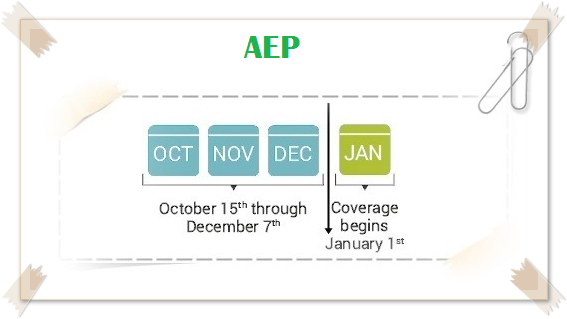
Annual Enrollment Period (also sometime referred as Fall Open Enrollment) is s that time of year when you can change your Medicare coverage. This Annual Enrollment period begins every year on October 15 and continues until December 7, for coverage date starting from January 1st following year.
So if you missed Initial enrollment Period, and don’t qualify for any other Special Enrollment Period then this is the only time available to you to enroll/or make any change in Medicare coverage.
During this period you are allowed to make any changes in your Medicare plans, such as;-
You can switch from Original Medicare to Medicare Advantage and vice versa
You can also switch from one Medicare Advantage plan to another
You can switch from one Medicare Part D (prescription drug) plan to another
You can join a new/or drop Medicare Part D coverage plan.
And if you didn’t enroll in a Medicare Part D plan when you were first eligible, you can enroll now, though a late enrollment penalty apply if your uncovered period > 63 days.
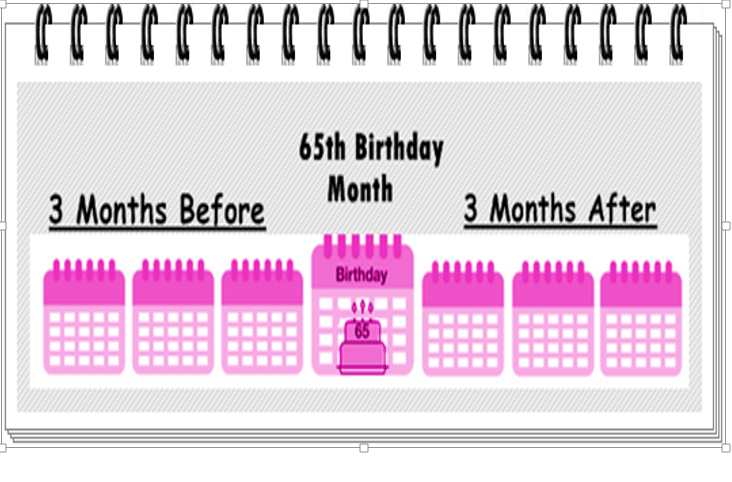
The Initial Enrollment Period (IEP) is your first opportunity when you can sign up for Medicare. You may join all the Medicare Parts A, B, C and D during this time. The date when your Medicare coverage begins depends on when you sign up.
Your IEP
is a seven-month period, including the three months before, the month of, and
the three months following your 65th birthday.
IEP
should be selected when the applicant is newly eligible for Medicare and
enrolling into a drug plan for the first time. This applies if enrolling
into either stand-alone PDP or Part D plan along with Medicare Advantage (MAPD).
If you missed your IEP, you may be able to enroll in Medicare
during a different enrollment period.
Initial Coverage Election Period (ICEP)
ICEP refers
to the period when individuals newly eligible for Medicare can enroll in the
Medicare Advantage Plan.
You may enroll in the Medicare Advantage plan with prescription drug coverage (MAPD) or without it (MA).
If you enroll in Part B when you turn 65, your ICEP is the same as your IEP. When you enroll later, your ICEP is the three-month period before your Medicare Part B coverage takes effect.
Like the IEP, the ICEP begins 3 months before the month of entitlement to Medicare. However, unlike the IEP, the ICEP ends either the last day of the month before you are enrolled in both Parts A and B; OR the last day of the IEP – whichever is later.
Consider two different scenarios;-
Enrolled in Part A and Part B during IEP
Let’s say your birthday is in
April 2019. So your IEP is from January 1 to July 31. And enroll in both
Medicare Part A and B effective April 1. In this case, your ICEP is the same as
IEP; from January 1 to July 31. This is the period when you are eligible to
enroll in the Medicare Advantage plan (with the effective date April or
later).
Delayed Part B
Now consider if your spouse’s
birthday was in May 2018. Now rather than enrolling in both Medicare Parts A
and B, he just joined Part A then, this is because he was still working then and
was covered by his employer group health plan.
But then when he retires next
year, he enrolls in Part B effective January 1, 2019. In this case his ICEP to
enroll in the Medicare Advantage plan is from October 1 through December 31,
2018.
If you miss this ICEP to enroll in Medicare Advantage, then your next opportunity would be at next Annual Enrollment Period (AEP) that runs from October 15 through December 7.
Initial Enrollment Period 2 (IEP2)
There
is another 7-month enrollment period called Initial Enrollment Period 2 (IEP2).
This
is for the people who are already eligible for Part A/B and before they turned
65.
During
the IEP2, you can sign up for a Medicare Advantage or Medicare Advantage
with Part D or standalone Part D prescription Drug plans.
The
IEP2 runs for the same seven-month period as the IEP.
Quiz
time:
If you are new to Medicare, and already enrolled in Part A and Part B, and now planning to enroll in Medicare Advantage plan without Part D (Rx) coverage – which election type should be used?
ICEP
– ‘I’ – since the person is enrolling MA plan election type ICEP – ‘I’ should
be used.
If you are new to Medicare, and already enrolled in Part A and Part B, and now planning to enroll in Medicare Advantage plan with Part D (Rx) coverage – which election type should be used?
IEP –
‘E’ – since the person is enrolling MA plan with Part D coverage (i.e. MAPD),
election type IEP – ‘E’ should be used.
If you are new to Medicare, and already enrolled in Part A and Part B, and now planning to enroll in Standalone Part D Plan (Rx coverage) – which election type should be used?
IEP –
‘E’ – since the person is enrolling in Standalone Part D coverage (i.e. PDP
plan), election type IEP – ‘E’ should be used.
If your IEP period expired, you delayed Part B enrollment, and plan to enroll in Medicare Advantage plan with or without Rx coverage (MA or MAPD) in the 3 months before Part B effective date
People who are eligible for premium free Part A, never have to pay any late enrollment penalty.
Who are not eligible for premium free Part A (i.e. who needs to pay premium to enroll in Part A) and didn’t sign up for Part A when first become eligible, then the person has to pay periodic penalty amount. So, it’s like your monthly premium may go up 10%, and you’ll have to pay the higher premium for twice the number of years you didn’t have had Part A, since the eligibility date.
Part B –
If you don’t sign up for Medicare Part B when you are eligible for the first time, you may have to pay a 10% penalty (added to your monthly premium).
But mostly you don’t pay a late enrollment penalty for Part B, if you meet certain conditions that allow you to sign up for Part B during a Special Enrollment Period. Like if you are working and covered by your employer’s group health coverage then you may delay your part B enrollment, and choose to enroll later, in that case you don’t have to pay penalty.
Part C –
Medicare Part C (Medicare Advantage plan) is optional, and there is no penalty for not signing up. But you must have Medicare Part A and Part B to get Part C.
Part D –
Talking about Late Enrollment
Penalty we mostly talk about Part D Late enrollment Penalty.
You ideally should sign up for Part D (prescription drug coverage) when you first become eligible for Medicare (i.e. between 65 years – 3 months, 65th birthday month, 65 years+3 months – which is your 7 month IEP period)
If you don’t enroll within the time period mentioned above, and remained uncovered and later on want to enroll in any Part D plan, you’ll have to pay a late-enrollment penalty if continuous Rx uncovered period is 63 days or more.
So you should enroll for Medicare Standalone Prescription Drug Plan (Part D), or Medicare Advantage plan that offers Prescription Drug coverage, or any other Credible Prescription Drug Coverage.
Medicare calculates the Late enrollment penalty (LEP) amount by multiplying 1% of the “national base beneficiary premium” ($33.19 in 2019) times the number of Part D uncovered months. The monthly premium is rounded to the nearest $.10 and added to your monthly Part D premium.
If you are 65+ and meet the citizenship and
residency requirements.
If you get disability benefits from Social
Security or the Railroad Retirement Board for at least 25 months.
Get disability benefits because you have ALS
(Amyotrophic Lateral Sclerosis, also called Lou Gehrig’s disease).
Have ESRD and meet certain requirements.
Medicare Part A is free if you –
Have at least 40 calendar quarters of
work in any job where you paid Social Security taxes in the U.S.
Are eligible for Railroad Retirement benefits
Or, if your spouse qualifies
for premium-free Part A
Else you have to pay premium–
Approx. $240/mo – If you or your spouse worked between 30 and 39 quarters (7.5 and 10 years).
Approx. $437/mo – If you or your spouse worked fewer than 30 quarters (7.5 years).
Premium amounts may change depending on several factors.
Part B
Who are eligible for Part B?
Anyone who is eligible for premium-free Medicare Part A is eligible for Part B by enrolling and paying a monthly premium.
If you are not eligible for premium-free Medicare Part A, you can qualify for Medicare Part B by meeting the following requirements:
You must be 65 years or older.You must be a U.S. citizen, or a permanent resident lawfully residing in the U.S for at least five continuous years.
You may also qualify for automatic Medicare Part B enrollment through disability, like if you are under 65 and receiving Social Security or Railroad Retirement Board (RRB) disability benefits for 24 months, or if you have end-stage renal disease (ESRD).
Part C
Who are eligible to enroll in Part C?
To be eligible for Medicare Part C, you must already be enrolled in Medicare Part A and Part B, and you must reside within the service area of the Medicare Advantage plan you want.
If you have end-stage renal disease (ESRD), you might not qualify for a Medicare Advantage plan in most cases. But there’s one type of Medicare Advantage plan that’s specifically meant for people with ESRD.
Part D
Who are eligible to enroll in Part D?
To
be eligible to enroll in a Medicare prescription drug plan (PDP), you must have
Medicare Part A and/or Part B and you must live in the service area for the
prescription drug plan in which you want to enroll.
To
be eligible to enroll in a Medicare Advantage plan with prescription drug
coverage (MAPD), you must have Medicare Part A and Part B, and you must live in
the service area for the MAPD plan you’re considering.





 medicare.news.blog