

Initial Enrollment Period (IEP)
The Initial Enrollment Period (IEP) is your first opportunity when you can sign up for Medicare. You may join all the Medicare Parts A, B, C and D during this time. The date when your Medicare coverage begins depends on when you sign up.
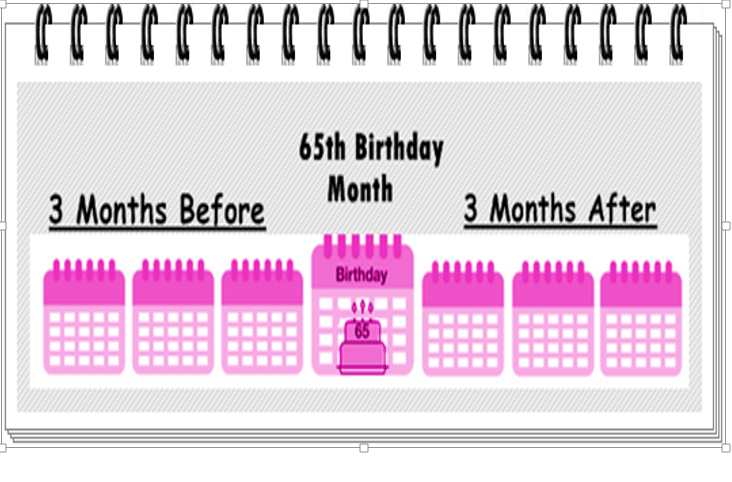
- Your IEP is a seven-month period, including the three months before, the month of, and the three months following your 65th birthday.
- IEP should be selected when the applicant is newly eligible for Medicare and enrolling into a drug plan for the first time. This applies if enrolling into either stand-alone PDP or Part D plan along with Medicare Advantage (MAPD).
- If you missed your IEP, you may be able to enroll in Medicare during a different enrollment period.
Initial Coverage Election Period (ICEP)
ICEP refers to the period when individuals newly eligible for Medicare can enroll in the Medicare Advantage Plan.
- You may enroll in the Medicare Advantage plan with prescription drug coverage (MAPD) or without it (MA).
- If you enroll in Part B when you turn 65, your ICEP is the same as your IEP. When you enroll later, your ICEP is the three-month period before your Medicare Part B coverage takes effect.
- Like the IEP, the ICEP begins 3 months before the month of entitlement to Medicare. However, unlike the IEP, the ICEP ends either the last day of the month before you are enrolled in both Parts A and B; OR the last day of the IEP – whichever is later.
- Consider two different scenarios;-
Enrolled in Part A and Part B during IEP
Let’s say your birthday is in April 2019. So your IEP is from January 1 to July 31. And enroll in both Medicare Part A and B effective April 1. In this case, your ICEP is the same as IEP; from January 1 to July 31. This is the period when you are eligible to enroll in the Medicare Advantage plan (with the effective date April or later).
Delayed Part B
Now consider if your spouse’s birthday was in May 2018. Now rather than enrolling in both Medicare Parts A and B, he just joined Part A then, this is because he was still working then and was covered by his employer group health plan.
But then when he retires next year, he enrolls in Part B effective January 1, 2019. In this case his ICEP to enroll in the Medicare Advantage plan is from October 1 through December 31, 2018.
If you miss this ICEP to enroll in Medicare Advantage, then your next opportunity would be at next Annual Enrollment Period (AEP) that runs from October 15 through December 7.
Initial Enrollment Period 2 (IEP2)
There is another 7-month enrollment period called Initial Enrollment Period 2 (IEP2).
- This is for the people who are already eligible for Part A/B and before they turned 65.
- During the IEP2, you can sign up for a Medicare Advantage or Medicare Advantage with Part D or standalone Part D prescription Drug plans.
- The IEP2 runs for the same seven-month period as the IEP.
Quiz time:
If you are new to Medicare, and already enrolled in Part A and Part B, and now planning to enroll in Medicare Advantage plan without Part D (Rx) coverage – which election type should be used?
ICEP – ‘I’ – since the person is enrolling MA plan election type ICEP – ‘I’ should be used.
If you are new to Medicare, and already enrolled in Part A and Part B, and now planning to enroll in Medicare Advantage plan with Part D (Rx) coverage – which election type should be used?
IEP – ‘E’ – since the person is enrolling MA plan with Part D coverage (i.e. MAPD), election type IEP – ‘E’ should be used.
If you are new to Medicare, and already enrolled in Part A and Part B, and now planning to enroll in Standalone Part D Plan (Rx coverage) – which election type should be used?
IEP – ‘E’ – since the person is enrolling in Standalone Part D coverage (i.e. PDP plan), election type IEP – ‘E’ should be used.
If your IEP period expired, you delayed Part B enrollment, and plan to enroll in Medicare Advantage plan with or without Rx coverage (MA or MAPD) in the 3 months before Part B effective date
ICEP – ‘I’ – should be used
 medicare.news.blog